Democrats Lead From Texas to Alaska, but Obama Warns Margins Could Vanish
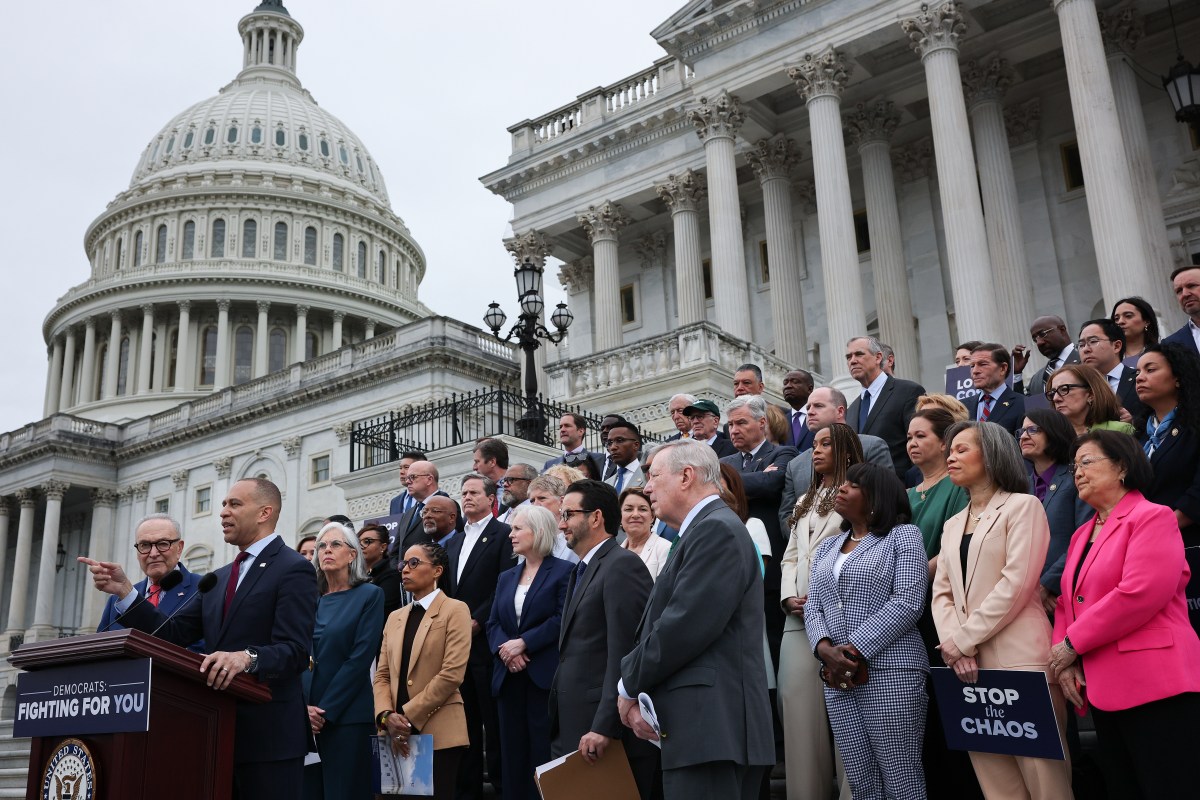
Democrats are entering the final stretch of the midterm campaign with numbers that look almost too good to be true.Senate Minority Leader Chuck Schumer, a New York Democrat, has declared that his party has "the wind in our sails." House Minority Leader Hakeem Jeffries, also a New York Democrat, told reporters on Sunday that they "are poised to take back the majority." Democratic Senate candidates now lead polling averages from Texas to Alaska, and in states President Donald Trump carried two years ago.But for many inside the party, the confidence comes with a warning attached. Midterms are, of course, a different contest. Voter turnout changes, Trump is not on the ballot, and history tends to favor the party out of power. Democrats are leading Republicans in almost every generic congressional ballot average.Still, with fewer than four weeks until Election Day and early voting already underway, Democratic leaders, strategists, and veterans of past wave elections are cautioning against the kind of overconfidence they say hurt the party last time."I will tell you that the antidote to overconfidence is the [20]24 election," Former North Dakota Senator Heidi Heitkamp told Newsweek. "People saw this in 24 and said it's not over till it's over."Heitkamp, a Democrat who lost her reelection bid in the 2018 wave, believes the defeat itself is what will keep her party from repeating it, but warned Democrats against reading too much into their lead."I think that the Democrats shouldn't get too cozy about saying that people are selecting the Democratic Party," she said. "I think they're rejecting the party of Donald Trump."The Wind in Their SailsThe Cook Political Report, widely considered the gold standard for nonpartisan race ratings, moved 18 House races toward Democrats last week. Party officials privately expect Democrats to win back the House, and the Senate, once seen as safer terrain for Republicans, now looks like a tossup.But some top Democrats are less sure the polls can be trusted. Former President Barack Obama warned donors at a fundraiser for Senate Democrats on Wednesday that narrow leads could evaporate."All these races that are showing we've got a two- or three-point lead or it's a tossup, we could end up losing all of them by two points," Obama said. "It's within the margin of error."The House may be slipping out of reach for Republicans, but the Senate is still up for grabs. The GOP holds a 53-47 majority, so Democrats need a net gain of four seats to take control. A 50-50 split would leave Vice President JD Vance with the tie-breaking vote.Their clearest openings are in North Carolina and Maine. In North Carolina, former Governor Roy Cooper leads Republican Michael Whatley 50.9 percent to 41.1 percent in the FiftyPlusOne polling average. In Maine, the only Republican-held seat in a state former Vice President Kamala Harris won in 2024, Democrat Troy Jackson leads Senator Susan Collins 49 percent to 46.7 percent.Beyond those two, the path to a majority runs through states Trump won comfortably. Former Senator Sherrod Brown leads Republican Senator Jon Husted in Ohio, 47.7 percent to 44 percent. In Texas, state Representative James Talarico leads Attorney General Ken Paxton 48.4 percent to 45.1 percent, and in Alaska, Democrat Mary Peltola leads Republican Senator Dan Sullivan 48.9 percent to 46 percent.Iowa and Kansas are closer still. Democrat Josh Turek holds a lead of less than a point over Representative Ashley Hinson in Iowa, while in Kansas, a race Cook just moved into its toss-up column, Democrat Adam Hamilton leads Senator Roger Marshall by 1.4 points. In Nebraska, Senator Pete Ricketts is ahead of independent Dan Osborn by less than a point.Democrats also have seats to defend. Progressive Abdul El-Sayed leads Republican Mike Rogers in Michigan, 48.1 percent to 44.4 percent, and Lieutenant Governor Peggy Flanagan leads by more than 3 points in Minnesota against Michele Tafoya, Republicans' best pickup opportunity. In Georgia, Senator Jon Ossoff holds a lead of about 9 points against Representative Mike Collins.Most of those margins sit inside the range Obama and other Democrats have warned about."Winning seats in red states during an era of hyper-partisanship will not be easy. Democrats have momentum, and the floor seems to be dropping out beneath the president's polling, but no Democrat should get comfortable," Doug Gordon, a Democratic strategist and co-founder of UpShift Strategies, told Newsweek. "Every Democrat should be running as if they're 10 points behind."The Ghost of October 2024The numbers from two years ago still haunt party strategists. Harris led Trump by an average of 3.6 points across national polls conducted in September 2024. October polls cut that edge to 1.7 points, and the RealClearPolitics average of surveys taken after October 9 showed her ahead by less than a point.The battlegrounds moved the same way. September polling had Harris leading in four of the seven swing states, while October surveys showed her ahead in just one.On Election Day, Trump carried all seven battlegrounds and won the national popular vote by about 1.5 points."Polls considerably underestimated Donald Trump and other Republicans on the ticket with him in 2016, 2020, and, to a slightly lesser extent, in 2024," statistician and election analyst Nate Silver wrote this past weekend. Silver added that polls in the two Trump-era midterms, 2018 and 2022, were essentially unbiased.For a party leaning on narrow margins, the difference matters. Recent polling averages found margin-of-error races in Michigan, Texas, Maine and Iowa, and a modest polling miss in either direction could reshape several of the contests that will decide the Senate. Gordon told Newsweek that while the winds are favorable, the party needs to temper its optimism."Election Day is not three weeks away," he said. "Election Day is every day for the next three weeks. Early voting is already happening, and more than 2 million votes have already been cast."Even Jeffries, who has compared this year to the 2018 wave, when Democrats regained control of the House, cautioned last Sunday that "anything and everything" is possible and urged Democrats to stay focused.Heitkamp said the political landscape is different this time around. Unlike Democrats in 2024, candidates are not running with the baggage of defending the Biden administration, which she said gives them more room to define themselves on their own terms."The Democratic candidate has an opportunity to define what they would do without having to answer for an administration that was not viewed favorably by the voters in their district," she said.A Different Kind of WaveThe last two midterms in which Democrats surged against an unpopular Republican president, 2006 and 2018, came when voters still felt relatively confident about the economy. The Iraq War dragged down President George W. Bush in 2006, and college-educated suburbanites abandoned Trump’s party in 2018.This year, the economy itself is the problem. Gas prices and interest rates are up, inflation has refused to ease, and Trump’s tariffs have driven up prices in rural America. The University of Michigan’s Index of Consumer Sentiment has fallen 33 percent since Trump returned to office in January 2025. In May, it hit its lowest point since monthly tracking began in 1952.Jim Kessler, executive vice president for policy at the centrist think tank Third Way, said the souring economy is what separates this cycle from a typical midterm swing.“I don’t think Democrats are peaking too early,” Kessler told Newsweek. “This feels like a gathering storm that could drown a lot of Republicans who thought they were in safe seats.”...Kessler, who said this is his 19th election cycle in Washington, has seen three others like it: 1994, 2006 and 2010. Two favored Republicans and one favored Democrats. In each, he said, voters were fed up with Washington, pessimistic about the economy and down on their own finances.“In the past, voters never really liked Trump all that much but at least they could say, ‘well, the economy is good,’” he said. “No one thinks the economy is good today and they rightfully blame the President because the tariffs and Iran War were his ideas alone.”Heitkamp sees the same frustration. Voters have been patient with the administration, she said, but they do not see it confronting the cost of living, housing and inflation with any urgency.“Instead, they hear stories about, you know, the reflecting pool and the east wing,” she said, referring to Trump’s renovation projects in Washington, including the demolition of the White House’s East Wing to build a ballroom.Costas Panagopoulos, a political scientist at Northeastern University, disputed the notion that Democrats have lost momentum. What matters, he said, is whether support is durable or merely superficial. "Democrats remain highly energized, with strong enthusiasm for defeating Republicans and a deep motivation to turn out on Election Day," he said.Is There Room for a GOP Comeback?Republicans can read the map. Trump rallied Monday in Grand Island, Nebraska, a state he won by 20 points in 2024, to shore up Ricketts, and stumped last week in Oklahoma, which he carried by 34. GOP groups are also spending to protect incumbents in Kansas and South Carolina.“I think the cake is baked, minus some external event which in this world is entirely possible,” Alex Patton, a Republican strategist with Ozean Media, told Newsweek. “The GOP isn’t going to solve inflation, the war, gas prices in the next few weeks.”Patton said Trump’s approval ratings will not jump 20 points before November's election. He added that Republican efforts to convince voters the economy is strong land “flat and out of touch.” The party has fallen back on fear to turn out its base, he said, “and even that appears to be failing.”Kessler put it more bluntly. “We’re less than a month from Election Day and Republicans are worried about losing a Senate race in Kansas,” he said. “It’s batten down the hatches time for the GOP.”A sweeping Democratic victory is still far from guaranteed. Republicans hold a large money advantage, with MAGA Inc. and other GOP groups outspending Democrats in every crucial Senate race. In Texas alone, Republican super PACs have directed more than $150 million to Paxton, compared with $4 million from Democratic super PACs for Talarico.“Is all lost for Republicans? No,” Kessler said. “They have several things going for them, including a huge money advantage and some underperforming Democrats in key states like Michigan and Maine in the Senate races."...The two races Kessler mentions are key for the Democratic hopes to regain the chamber. In Michigan, a seat Democrats must hold, El-Sayed has struggled to open a meaningful lead over Rogers, with most polling putting him ahead 50 percent to 49 percent among likely voters. Before the August primary, several polls showed the Republican beating the progressive former public health official.In Maine, meanwhile, Democrats lost valuable time after a messy nomination fight. Oyster farmer Graham Platner forced Governor Janet Mills out of the race in April and went on to win the June primary, but he withdrew in July following a sexual assault allegation. The state party then nominated former state Senate President Troy Jackson on July 25. Jackson now leads Collins by just over 2 points.Then, there is the Democratic brand itself, which remains a drag on the party even as voters sour on Trump. Democrats are still underwater nationally, posting a 44 percent favorable and 55 percent unfavorable rating in a recent Fox News poll and a 38 percent favorable, 58 percent unfavorable rating in a recent Wall Street Journal survey. Dissatisfaction extends beyond the party's broader image: Schumer and Jeffries have also struggled to win over voters, including many on the left.Patton sees no sign Democrats are coasting. But he would treat any race within 10 points as unfinished.“You gotta run through the tape and leave nothing to chance,” he said.Heitkamp has a similar conclusion. Two years after watching her party’s lead slip away, she said Democrats are more worried about history repeating itself than about anything else.“I don’t think that there will be kind of an overconfidence,” she said. “I think there will be a huge push to push through the tape at the end.”Newsweek’s reporters and editors used Martyn, our AI assistant, to produce this story. Learn more about Martyn here. Contact Newsweek editors for this story: Jason Lemon and Anthony Murray.