Mile 18: The Surprising Breaking Point for NYC Marathon Runners
See more of our coverage in your search results.
This is where they admit de feet.
Mile 18 has proven to be the toughest point of the New York City Marathon — and is where quitters are statistically inclined to rip off their racing bibs and give up, The Post has learned.
Dubbed “The Wall,” the 7-block stretch of Upper East Side combines a perfect storm of factors to drive even dedicated runners to abandon their dreams — including a lack of crowds cheering you, a distance where the body starts to break down and, even, the convenience of being in Manhattan.
“You go through Brooklyn — which is an insane adrenaline rush and amazing experience — you go through Queens, which is great, then when you come off of the 59th Street Bridge, it’s like nothing you’ve ever experienced before,” said Annie Reeves, who ran her first marathon in 2023.
“You go to all of these phases of amazing, unmatched energy where people are pulling you through. And Mile 18 is a low point.”
Last year, 203 runners gave up the ghost between mile 18 and kilometer 30, which is 18.6 miles, making it the area with the highest loss of runners on the course, according to Road Runners data.
That stretch lies along a fairly quiet area of First Avenue between 96th to 103rd streets, which is littered with parking lots, sports fields and municipal buildings rather than apartments.
It’s where the wall-to-wall crowds begin to thin out and runners face comparative silence — especially coming off the heels of the deafening roars that greeted them off the Queensboro Bridge just two miles prior.
It also precedes the steepest ramp of the course just before Mile 20 — the Willis Avenue Bridge — for the race’s brief foray into The Bronx.
And while many runners traditionally count the hill at mile 20 as the proverbial “wall,” recent data tells a different story.
Mile 18, which is just 70% into the race, has proven to be the most common give-up point throughout the sprawling, five-borough course across the most recent decades.
“It’s likely that runners who are having tough days decide to cut their marathon short and wait until they’re back in a convenient location in Manhattan to drop out,” Road Runners told The Post. It may be no coincidence that the start of the stretch is a block from the Second Avenue subway.
But Omar Medjid, founder of the World’s Fair Run Crew, theorizes that the pain of Mile 18 is universal regardless of the course.
“That’s when you start looking at your watch, you’re kind of panicking and you’re just saying, ‘Okay, am I going to hit my goal time? Is my pace dropping?’ You start to feel it in your body versus the actual data,” said Medjid, 33, of College Point, who ran the NYC Marathon in 2024.
“You’re already tired from hitting the bridge and everything, then you know you still got that long stretch of Fifth Avenue to go. A lot of mental was really what it would be, but I do think it’s mainly based on the actual mile rather than exactly where it is.”
What pulled Medjid through was seeing his friends and fellow running community members along the route — which helped him remember why he was running the race.
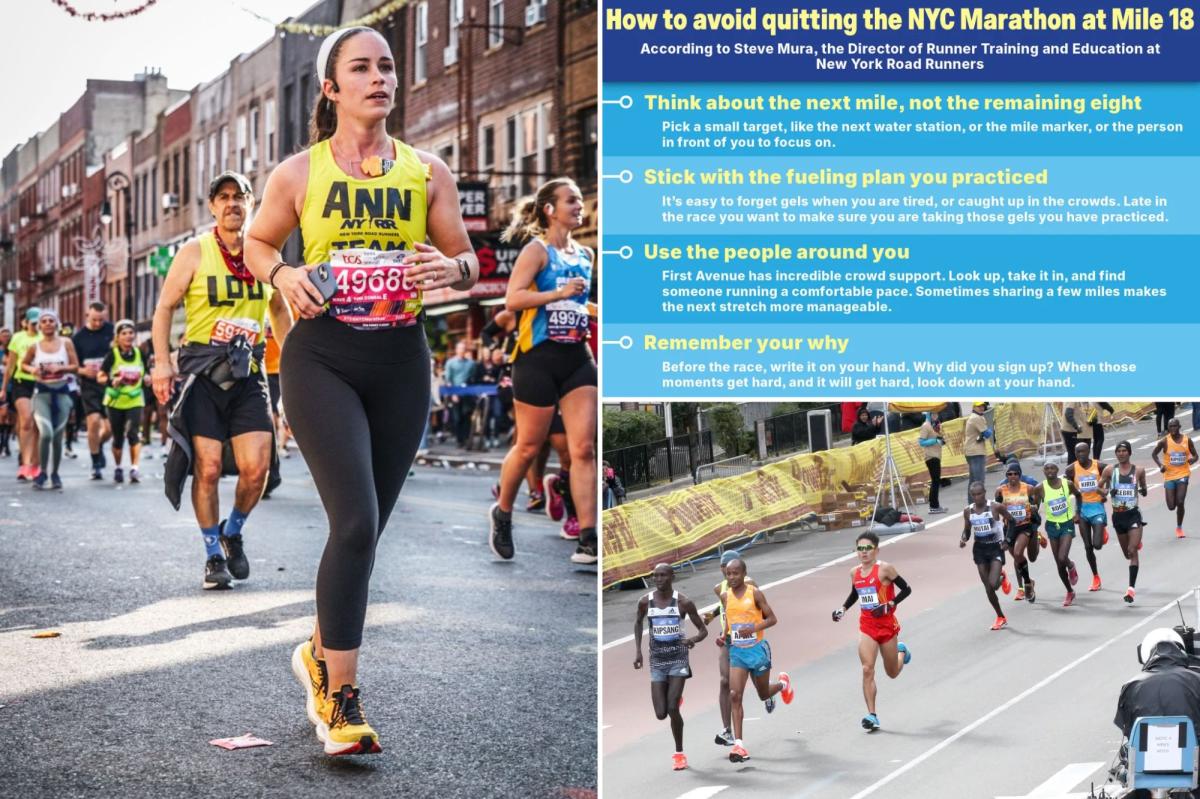
“Remember your why” is a major piece of advice Road Runners coach Steve Mura offers racers when pushing through “The Wall” and toward the finish line.
“Before the race, write it on your hand. Why did you sign up? When those moments get hard, and it will get hard, look down at your hand,” said Mura, the organizer’s director for Runner Training and Education.
“Think about the next mile, not the remaining eight.”
Pack plenty of fuel, keep your eyes peeled for water stations and use the cheering crowds to your advantage, he continued.