
RFK Jr.'s Beef Tallow Push: Why It's Stirring Health Debates
Over the past several months, restaurants, fast food chains and major companies have said they are transitioning away from seed oils and adding beef tallow to their products instead.
In February, Utz announced it was planning to launch a new line of kettle chips cooked in beef tallow under its Boulder Canyon brand, tapping "into growing consumer demand for snacks made without seed oils." Other Utz products are cooked in a blend of seed oils.
Last year, the chain Steak 'n Shake announced it was removing seed oils from all fried products and buns, cooking its French fries, tots, onion rings and chicken tenders in 100% beef tallow.
"Our fries will now be cooked in an authentic way, 100% beef tallow, in order to achieve the highest quality and best taste," Chris Ward, chief supply chain officer for Steak 'n Shake, told Restaurant Business in a statement.
Beef tallow, which is animal fat from cows that is used in cooking but also for industrial purposes like soap and candle-making, has been promoted by Health and Human Services Secretary Robert F. Kennedy Jr., who claims seed oils are one of the causes of high obesity rates in the U.S. and are linked to chronic disease.
Kennedy has said Americans are being "unknowingly poisoned" by seed oils and that fast food restaurants switched from beef tallow to seed oils in their fryers because "saturated animal fats were thought to be unhealthy."
"I don't have anything against fast food; I'm against food that has seed oils," he said during a "Fox & Friends" interview in late 2024.
Doctors, however, say rhetoric about seed oil risks may be misleading the public about healthy eating.
Secretary of Health and Human Services Robert F. Kennedy Jr. listens during a news conference at the at the Robert F. Kennedy Department of Justice building on June 23, 2026 in Washington, DC.
Anna Moneymaker/Getty Images
Dr. Amit Khera, who helps write dietary guidance at the American Heart Association, said he's concerned about consumers changing their behaviors, such as "actively consuming beef tallow when they weren't doing it before or replacing healthy oils for unhealthy sources of saturated fat."
He added, "It's one thing if you don't want to do oils in general. It's different if you are actively reaching out for products that are high in saturated fats that we know can increase your cholesterol and adverse effects for cardiovascular effects."
Are seed oils more beneficial?
Seed oils are polyunsaturated fats extracted from plant seeds with some of the most common sources being soybean, canola, sunflower, corn, grapeseed, sesame, cottonseed and safflower.
Cardiologists and nutrition specialists told ABC News there are benefits in consuming polyunsaturated fats, which may extend to seed oils.
"Across all of these different types of studies ... the benefits are pretty dramatic, pretty positive, pretty consistent," Dr. Darius Mozaffarian, a cardiologist and director of the Food is Medicine Institute at Tufts University, told ABC News.
Mozaffarian said seed oils can help lower glucose levels, improve insulin sensitivity, reduce bad (LDL) cholesterol, reduce triglycerides and increase levels of positive (HDL) cholesterol.
"They're consistently linked to low risk of cardiovascular disease, lower diabetes, lower risk of dying from all causes and then, in the randomized control trials that have been done mostly with soybean oil, they also significantly reduced heart attacks," Mozaffarian said. "So, this is about as open and shut a case in nutrition as we have."
Popular Reads
Opponents of seed oils claim that small amounts of the chemicals used to press the oils may be present after processing. Mozaffarian said the benefits "far, far, far outweigh any harms" from the trace amounts of chemicals.
One example is hexane, which is the primary solvent that separates oil from crops. Generally only trace amounts are left over in food.
Additionally, seed oils are high in omega-6 fatty acids, which some have said cause inflammation. Mozaffarian argued seed oils are not pro-inflammatory.
"These fats do not activate inflammation and, in fact, they seem to temper inflammation," he said.

Stock photo of a person with cooking oil in their shopping basket.
Theerawit Jirattawevut/STOCK PHOTO/Getty Images
Kennedy has argued that seed oils cause chronic inflammation. But blaming seed oils for the declining health of Americans ignores the broader context of America's dietary shift, according to Mozaffarian.
"Americans have become so sick in the last 30 years from ultra-processed foods, from the refined grains and starches, the sugar, the salt, all the additives that people are very are fed up with highly processed foods. This is another reason why seed oils get a bad rap -- people consider them highly processed because of the way they're extracted," Mozaffarian said.
Is beef tallow a healthy option?
Some have expressed concern on social media about what is healthier to cook with -- beef tallow or seed oils.
Some restaurants that are transitioning from seed oil to beef tallow have also reported using more butter and olive oil in their cooking.
Beef tallow does provide some essential fat-soluble vitamins, including A, D, E, and K. Red meat has saturated fat though, which is "probably the most harmful," Mozaffarian said. "[Beef tallow] has a certain type of saturated fat called palmitic acid, which is most strongly linked to harms."
Saturated fat is linked to high cholesterol and and related conditions, such as heart disease, according to the Centers for Disease Control and Prevention.
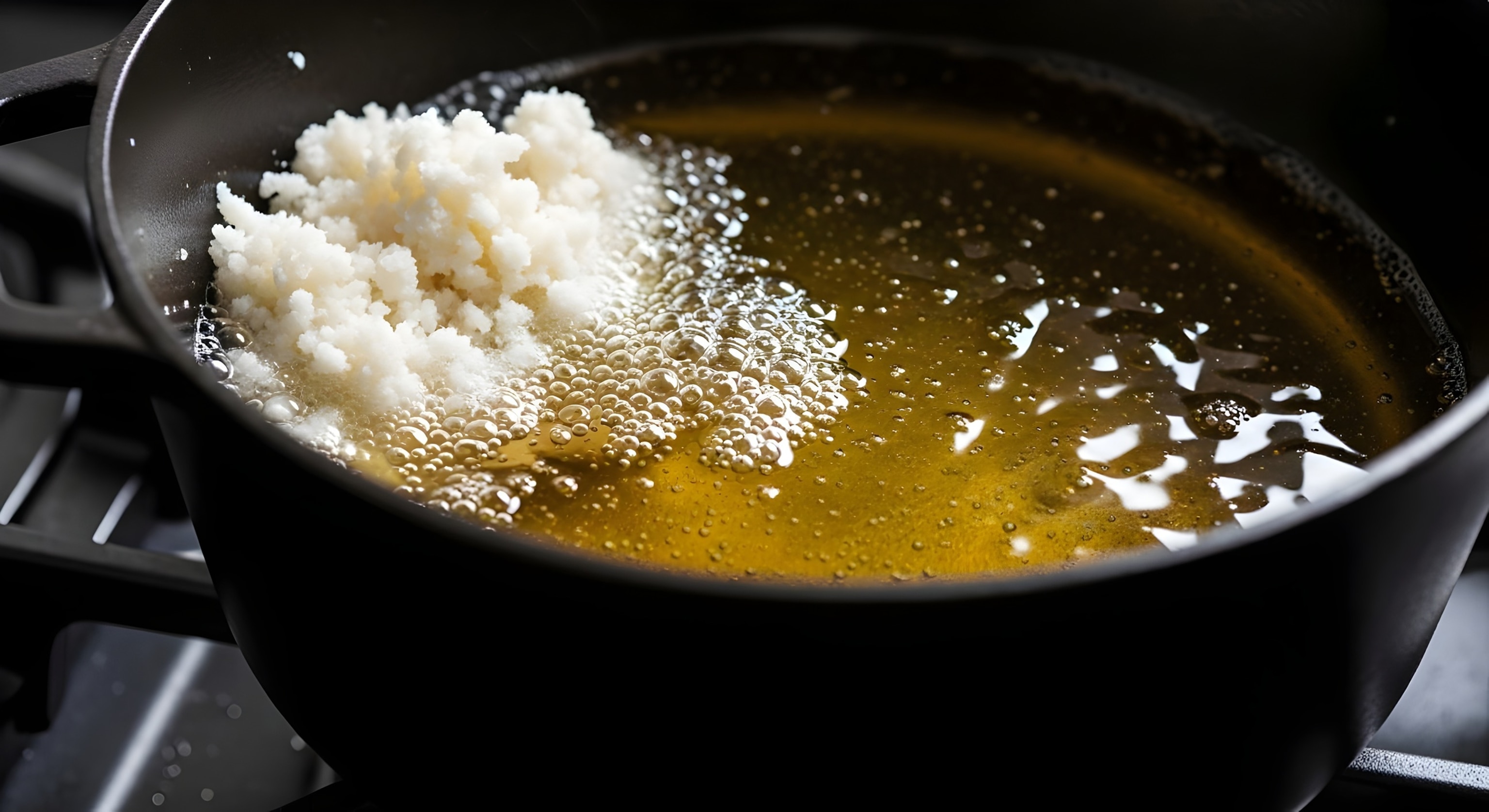
Stock photo of beef fat being rendered into tallow.
Becheer/Adobe Stock
Excessive consumption of saturated fat intake has also been linked to rising levels of "bad" LDL cholesterol in your blood and increasing the risk of heart disease and stroke, according to the American Heart Association.
Saturated fats can also cause weight gain, affect metabolic health and increase the risk of developing diabetes, heart disease and other health issues, according to the National Library of Medicine.
Some studies have found that the source of the fat and one's overall diet matter much more than simply avoiding animal fats. A 2018 study from the Harvard T.H. Chan School of Public Health found that a higher intake of plant-based fats was linked to a lower risk of dying from any cause while a higher intake of animal-based fats was linked to a higher risk of dying.
"Beef tallow isn't something you actively consume to improve your health. It's just a question of, 'When you're preparing, which of two choices do you use?'" Khera said. "Are seed oils actually bad for you by themselves? It does not seem to be that way."