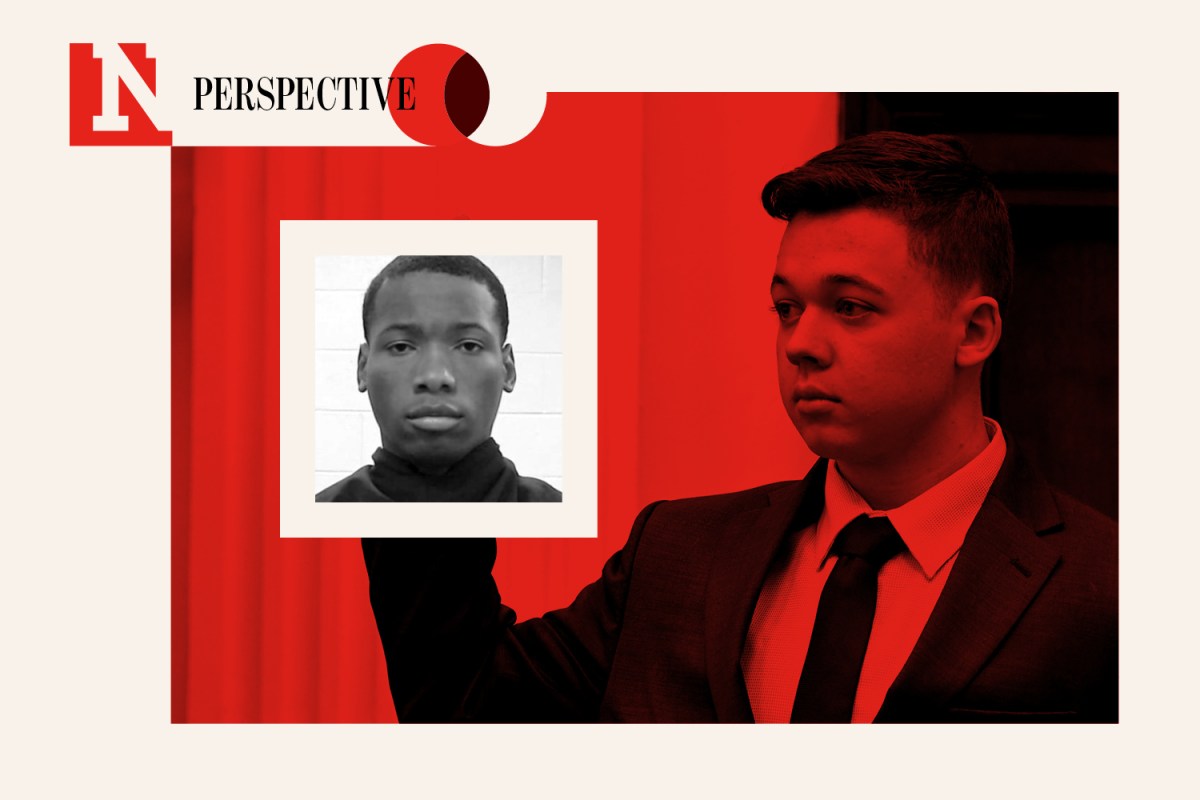
Why Are These Two Self-Defense Cases Dividing America?
The cases of Karmelo Anthony and Kyle Rittenhouse are both rooted in arguments about lethal self-defense, but their trials ended with very different conclusions.
To supporters of Anthony, a Black teenager just sentenced to 35 years in a Texas prison for murdering white 17-year-old Austin Metcalf in an altercation at a track meet, there is a clear racial double standard.
Rittenhouse, who is white, was also just 17 when he shot three men, two of them fatally, in Wisconsin amid the disorder of a Black Lives Matter protest. He was acquitted.
Perhaps inevitably, these cases have polarized in opposite ways, depending in large part on the political and racial biases of the beholder. It’s an observation not lost on Rittenhouse.
“The same people that are screaming self-defense for Karmelo Anthony are the same ones that are screaming that I’m a murderer or white supremacist or a Nazi for defending myself against three white guys,” Rittenhouse told Newsmax.
Progressive commentator Ryan Shead framed Anthony’s case as self-defense while characterizing Rittenhouse’s as “murders.”
“If only we knew what the difference was?” Shead wrote on X, sharing images of the two, alluding to the fact that one is white and the other Black.
There are parallels between the two cases. Anthony crying in court was a visual echo of Rittenhouse’s own emotional response when taking the stand.
But there are also some very clear and significant differences, even if Americans have learned to decide whose fear sounds reasonable before all the evidence arrives.
The Comparison Begins With Difference
Rittenhouse was acquitted in November 2021 after his lawyers argued self-defense in the Kenosha shootings that killed Joseph Rosenbaum and Anthony Huber and wounded Gaige Grosskreutz.
Rittenhouse had gone to Kenosha, armed with an AR-15-style rifle, during unrest after police shot and wounded Jacob Blake. The teen said he had gone to help defend local businesses against vandalism during the protests.
While there, he faced physical assault by some of the protesters, one of them hitting him with a skateboard. Once self-defense was at issue, Wisconsin put the burden on prosecutors to prove the shootings were unjustified.
Anthony’s facts moved through a different legal frame. He had gone under Memorial High School’s tent after a rain shower. His coach testified that his own team’s tent had not arrived on the morning bus.
It was there that a confrontation ensued with Metcalf, who was unarmed and trying to push Anthony out from under his school’s tent. The altercation ended with a single stab wound to Metcalf’s chest that the county medical examiner testified was not survivable.
Texas law permits deadly force when a person reasonably believes it is immediately necessary to protect against unlawful deadly force or certain grave crimes.
A separate provision strips the justification from anyone who provoked the other person’s force, unless he abandoned the encounter, or clearly communicated an intent to, and the other person kept coming.
Anthony’s defense team made the argument that the killing was a moment of fear-induced passion as he came under attack by Metcalf, and was not a pre-meditated act of violence. It was, they said, an act of impulsive self-defense.
But the prosecution’s argument in Anthony’s case was about proportionality.
“You don’t get to meet a shove with a stab, especially if you provoke the shove,” prosecutor Bill Wirskye told jurors in his closing argument.
Wisconsin law also turns on reasonable belief and necessity, but it permits force to prevent or end unlawful interference, and reserves deadly force for imminent death or great bodily harm.
Rittenhouse has long maintained that his life was at threat when he was assaulted by protesters in Kenosha.
Jurors in Rittenhouse’s trial had one significant benefit over those in Anthony’s: the incidents were caught, clearly, on multiple cameras. Anthony's jury had surveillance video too, but the decisive seconds under the tent were far harder to read.
Teenagers Become Adult Politics
The two cases became symbols before most Americans could have explained the underlying law. Rittenhouse’s case became a flashpoint in debates over guns, vigilantism and racial injustice.
Anthony’s case became a national story shaped by bail, misinformation and race long before a jury was seated.
Within two weeks of Metcalf’s stabbing, MAGA voices were raging over Anthony’s bond, while his defenders were already invoking Rittenhouse.
The weapons inverted the politics. Rittenhouse's rifle arrived politically loaded—he carried it into a city already convulsed by protest and unrest, and everyone who saw it knew what it meant and why he was there.
Anthony's knife was just a pocketknife in a backpack until the moment it wasn't; it became politically loaded only after the stabbing, once the case was absorbed into fights over race, school violence and criminal justice.
The comparison works only when it respects those differences.
Self-defense law depends on microscopic facts, but the politics depends on tribal recognition. One case passed through gun-rights, riot and Black Lives Matter politics, the other passed through race, school-safety and perceived-double-standard politics.
Rittenhouse and Anthony are not legal twins, they are political mirrors.
Fear as a Team Sport
Rittenhouse testified, “I didn’t do anything wrong. I defended myself,” while prosecutors described him as the aggressor who never faced an imminent threat of death or great bodily harm.
Anthony did not take the stand. His lawyers told jurors he acted in a “split second of fear and chaos” after being confronted and pushed by the larger Metcalf; prosecutors called the stabbing a provoked, unjustified “sneak attack.”
The testimony cut both ways. One witness said Anthony reached into his bag and warned, “Touch me and see what happens,” and that Metcalf replied, “I’m not going to fight you”.
A defense witness recalled hearing Anthony say afterward, “I told him not to touch me.” A coach who spoke to Anthony on the track testified that Anthony told him, “He put his hands on me. I stabbed him.”
Those facts do not collapse into one verdict. They expose a reflex.
Many Rittenhouse supporters treated his fear as the whole moral universe, while many Anthony supporters treated his fear as the missing context.
And many Rittenhouse opponents treated his decision to bring a rifle to Kenosha as the fact that swallowed his claim of self-defense, while many Anthony opponents treated the knife and the school setting as the facts that swallowed his.
The right is inconsistent when it treats Rittenhouse’s fear as sacred and Anthony’s as fake. The left is inconsistent when it treats Anthony’s fear as context and Rittenhouse’s as morally irrelevant.
The same sentence keeps changing sides: He was scared; fear is no excuse. But the law cannot work that way.
Race Matters, But So Do Facts
Race belongs in the Anthony story because it was central to public attention. The trial drew national scrutiny because Anthony is Black, Metcalf was white and none of the jurors were Black, though some were people of color.
The defense raised a Batson challenge after prosecutors struck three Black female prospective jurors; prosecutors gave a nonracial explanation tied to the women’s occupations as educators, and Judge John Roach allowed the strikes.
The trial’s own principals resisted the racial frame. Wirskye told jurors in his opening that the case was not about race or self-defense. After the verdict, Austin’s father, Jeff Metcalf, said it “was never about race or politics.”
Neither statement settles the question—prosecutors and grieving fathers are not neutral arbiters of what a case is about. But both cut against the assumption that every courtroom fact arrives pre-racialized.
That controversy deserves scrutiny because jury confidence is part of the justice system’s operating machinery. It also requires precision.
A racial dispute over jury selection does not make Anthony’s trial evidence identical to Rittenhouse’s. A society can take racial distrust seriously without flattening two different self-defense records into the same case.
There’s a strong counterargument to this whole comparison: Rittenhouse faced a series of confrontations amid unrest in Kenosha, while Anthony stabbed another student during a school-track dispute under a tent.
That distinction defeats lazy equivalence, but it still leaves the political mirror intact.
Tribal Loyalty
Self-defense law slows a story down, asking who moved first, who touched whom, who had a weapon, who threatened what, who provoked, who could retreat and what a reasonable person would have believed when force was used.
The politics of self-defense, on the other hand, speeds a story up and blurs important nuances: rifle or knife, protest or track meet, white or Black, right-coded or left-coded, victim or villain.
Two ideas can be true at once.
Rittenhouse’s acquittal can be legally understandable under Wisconsin’s self-defense framework, while his presence in Kenosha with a rifle remains reckless and corrosive civic behavior.
Anthony’s conviction can be legally understandable under Texas’s deadly-force standard, while a 35-year sentence for a teenager and a no-Black-juror panel remain grounds for scrutiny.
That scrutiny cuts both ways: jurors were offered a “sudden passion” finding that would have lowered the sentencing range to two to 20 years, and they rejected it; Anthony will also be eligible for parole after serving half his term.
Americans say self-defense is universal until the wrong defendant claims it. Then “reasonable fear” becomes whatever the tribe needs it to be. The jury room still has rules, even if the country outside keeps trying to replace them with tribal loyalty.